


Macular Degeneration, also known as Age-related Macular Degeneration (AMD), is the leading cause of irreversible vision loss in adults over 60, affecting nearly 20 million Americans. The risk of developing AMD increases with age. If you are 75 or older, your risk is 1 in 3. There is also a juvenile form of macular degeneration called Stargardt disease, and while the vision loss is similar, the causes, and potential treatments, are different.
At present, AMD is considered an incurable eye disease.
While the origins of AMD are still unknown, science has uncovered many of the genetic and environmental factors that contribute to its development, along with the body’s malfunctioning mechanisms that causethe deterioration of macula — the central portion of the retina.
The retina is the thin tissue that lines the inside back layer of the eye and transforms light from the images we see into nerve impulses, then sends them via the optic nerve to the brain, where vision occurs. The macula is responsible for capturing detailed information from the center of our visual field, and it gives us our ability to read, drive a car, recognize faces, perceive color and contrast, and see fine details.
Illustrations of the anatomy of a normal human eye and loss of central vision:
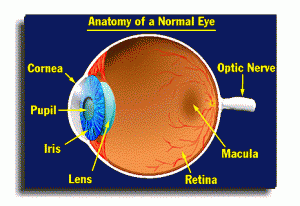

When the cells of the macula deteriorate, images are not received correctly. In early stages, macular degeneration does not affect vision other than a diminished ability to see in low light. Later, if the disease progresses, people experience wavy or blurred vision, and, if the condition continues to worsen, central vision may be completely lost. People with very advanced macular degeneration are considered legally blind. Even so, because the rest of the retina is still working, they retain their peripheral vision, which is not as clear as central vision.
Types of Macular Degeneration
There are two basic types of Macular Degeneration: “dry” and “wet.” Approximately 85% to 90% of the cases of Macular Degeneration are the “dry” (atrophic) type, while 10-15% are the “wet” (exudative) type.
Click here to learn more about the types of macular degeneration.
Stargardt disease is a form of macular degeneration found in young people, caused by a recessive gene.
Stages of Macular Degeneration
There are four stages of Age-related Macular Degeneration (AMD).
Sub-clinical AMD — Before any of the visible, physical changes to the macula that accompany the later stages of the disease, people start to lose their ability to adapt to dark surroundings. This loss of dark adaptation is more pronounced than the loss of dark adaptation that happens to most people later in life, and must be measured in a doctor’s office.
Early AMD – Most people do not experience vision loss in the early stage of AMD, which is why regular eye exams are important, particularly if you have more than one risk factor (see below). Early AMD is diagnosed by the presence of medium-sized drusen (yellow deposits beneath the retina).
Intermediate AMD – At this stage, there may be some vision loss, but there still may not be noticeable symptoms. A comprehensive eye exam with specific tests will look for larger drusen and/or pigment changes in the retina.
Late AMD – At this stage, vision loss has become noticeable, due to either advanced dry AMD (geographic atrophy) or wet AMD.
Click here to learn more about the stages of macular degeneration.
If you have already been diagnosed with Macular Degeneration, here are Ten Questions to Ask Your Doctor.
Causes of AMD
The specific cause of macular degeneration is not conclusively known, but the interplay between known hereditary and environmental factors is complex. The more that scientists understand the mechanisms that cause the cells of the macula to deteriorate, the more potential treatments they can develop to slow or stop the disease. The challenges are great, because multiple genes are associated with AMD and environmental factors — such as smoking, diet and sun exposure — also impact the disease.
Risk Factors
The biggest risk factor for Macular Degeneration is age. Your risk increases as you age, and the disease is most likely to become apparent in those 55 and older, even though it might start to develop earlier.
Other risk factors include:
- Genetics – People with a family history of AMD are at a higher risk.
- Race – Caucasians are more likely to develop the disease than African-Americans or Hispanics/Latinos.
- Smoking – Smoking doubles the risk of AMD, and recent studies have found that living in an air-polluted environment also increases risk.
- Diet — a poor diet, high in saturated fats and cholesterol and low in antioxidants, can increase risk for AMD accelerate its progression.
Click for more explanation of risk factors.
Treatment
There is currently no known cure for Macular Degeneration, but treatments are available for the wet form of late AMD.
Treatments for the dry form of AMD are in clinical trials, but are not yet available to patients. Click here to learn more about clinical trials.
There are things you can do to reduce your risk and possibly slow the progression once you’ve been diagnosed. These consist of lifestyle choices, whose benefits are cumulative, meaning doing two is better than one, three is better than two, etc.
- avoiding smoking
- eating an AMD-healthy dieti
- exercising regularly
- maintaining recommended body weight
- maintaining recommended blood pressure
- protecting your eyes from ultraviolet light
An educated, motivated patient who takes an active role in the aspects of disease management that they can control is likely to have the best outcomes and preserve more vision.
Click for more information on treatments for advanced stage AMD and 10 Things You Can Do to Improve Your Vision.
The impact of Macular Degeneration
In addition to vision loss, AMD can affect your mobility, your independence, your ability to perform household activities like cooking and maintaining your finances, relationships with others, and your sense of self. Depression, cognitive decline and an overall decline in health have all been associated with AMD.
AMDF suggests that you seek out resources to help you to address any of these co-morbidities. Start by asking your doctor. Take advantage of the resources in this website. Reach out to AMDF if you need additional help.
How Does AMDF Support Macular Degeneration Research?
The American Macular Degeneration Foundation supports important research into the causes of age-related macular degeneration, potential cures and treatments, and into developments that can improve the quality of life for all of those affected by the disease.
Click here to learn more about AMDF Research.
Your donations can make a difference. Click to learn how your generosity can contribute to treatment breakthroughs in macular degeneration.
Did you find this content helpful?
Would you like to be part of bringing this information to the public? All our educational materials, including this website, are made possible by individual donations from people just like you. If you have the ability to contribute, you can support these efforts.